

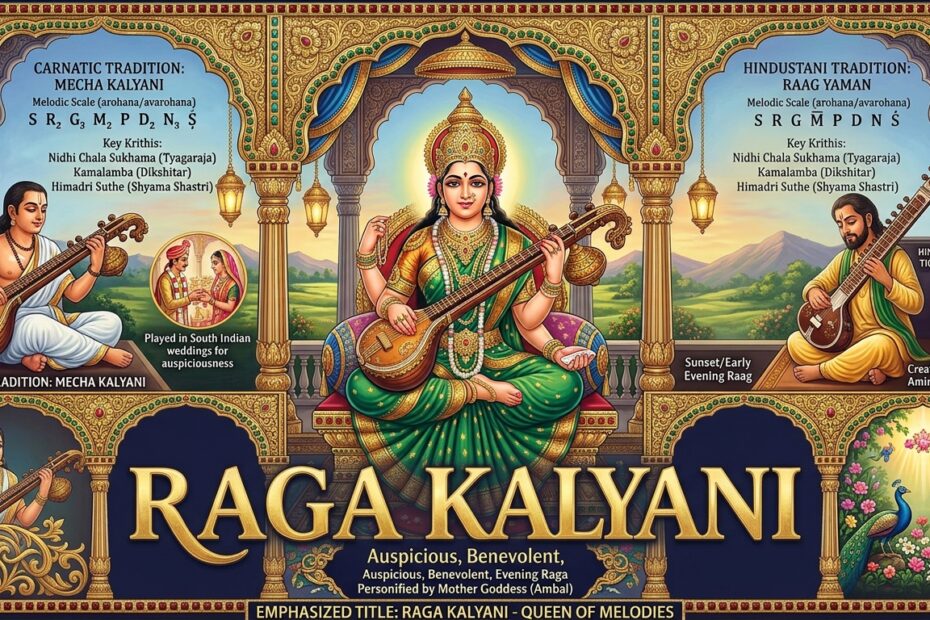
A brief introduction of Mecha Kalyani Raga
Kalyani, also known as Mechakalyani, is the 65th Melakarta raga in the Carnatic music system. It is one of the most prominent and expansive ragas in Carnatic music and is classified as a Sampurna raga, using all seven swaras in both ascending and descending movement. Its basic pitch collection corresponds broadly to the Kalyan/Yaman family in Hindustani music and to the Lydian mode in Western music, although a raga is defined by much more than its scale alone.
The name Kalyani is associated with auspiciousness and well-being. The raga has traditionally been regarded as bright, majestic and auspicious, and is frequently heard in concerts and ceremonial settings, including South Indian weddings. Kalyani also has considerable scope for elaborate alapana and other forms of musical improvisation.
Kalyani occupies an important place in the Melakarta system. It is the fifth raga of the 11th chakra, Rudra, and is the prati madhyama counterpart of the 29th Melakarta, Dheerasankarabharanam.
Significance of Raaga Mecha Kalyani
Kalyani is particularly significant because of its place in the development and classification of the Melakarta system. Traditional discussions of the raga also associate it with Graha Bhedam, or a modal shift of the tonic, in relation to older theoretical concepts such as Shadja Grama. These historical theories are part of the broader evolution of Indian musical thought and should be understood in the context of the different systems used to classify and describe ragas over time.
The raga is traditionally associated with qualities such as grandeur, brightness, devotion and auspiciousness. Its expansive melodic character gives musicians considerable freedom for elaboration, making it particularly suitable for alapana, kriti rendition, neraval and swara kalpana.
To know more about this Melakarta Janaka and Janya raaga system refer to Janaka Raagas Explained
Lakshana and Structure – Aarohana and Avarohana is as follows: –
The basic arohana and avarohana of Kalyani are:
The raga uses shadjam (S), chatushruti rishabham (R₂), antara gandharam (G₃), prati madhyamam (M₂), panchamam (P), chatushruti dhaivatam (D₂), and kakali nishadam (N₃). Since all seven swaras occur in the basic scale, Kalyani is classified as a Sampurna raga.
However, Kalyani should not be understood merely as a sequence of seven notes. Its identity comes from the characteristic melodic phrases, emphasis on particular swaras, gamakas and the manner in which the notes are developed. This is what gives the raga its distinctive personality beyond its scale structure.
Listen to scale of Mohana Raaga:
Timing of the Raaga
Kalyani is traditionally considered a sarvakalika raga, meaning that it can be performed at different times of the day. Some traditional sources particularly associate it with the evening and suggest that its effect is especially appealing at that time. It is also frequently chosen near the beginning of concerts because of its bright and auspicious character.
Mood of the Raaga
Kalyani is often described as a bright, majestic and expansive raga. Depending on the composition, rendition and musical treatment, it can evoke devotional, joyful, romantic, serene or deeply contemplative moods.
The prati madhyama and the characteristic treatment of its swaras contribute to its distinctive brilliance and grandeur. For listeners, Kalyani can be especially rewarding because it offers both immediate melodic appeal and considerable depth for exploration.
Rather than attributing specific medical or psychological powers to the raga, it is more appropriate to speak of the traditional aesthetic and emotional associations of Kalyani. Individual listeners may experience music differently, and the effect of a raga can vary according to the performer, composition, context and listener.
Significant compositions of Mecha Kalyani Raga
Kalyani has a rich repertoire of compositions by several major composers of Carnatic music.
Varnams
- Ninnu Kori – traditionally attributed to Ramnad Srinivasa Iyengar
Kritis
Some well-known compositions in Kalyani include:
- Nidhi Chala Sukhama – Tyagaraja
- Vasudevayani – Tyagaraja
- Amma Ravamma – Tyagaraja
- Himadri Suthe – Shyama Shastri
- Kamalambaam Bhajare – Muthuswami Dikshitar
- Bhajare Re Chitta – Muthuswami Dikshitar
Kalyani has also been an important raga for many great musicians, particularly in elaborate alapana, neraval, swara kalpana and Ragam-Tanam-Pallavi presentations.
Kalyani Renditions on MusicNamaste Website:
Disclaimer:
The information presented in this article is intended for educational and general music-appreciation purposes. Descriptions of the mood, aesthetic qualities and traditional associations of a raga are part of musical and cultural traditions and should not be interpreted as medical claims or as a substitute for professional medical advice.